Raised Beds Without Guesswork
A four-foot-wide raised bed exists for one ergonomic reason: the average adult can kneel beside the side wall and comfortably reach 24 inches to the center line without ever stepping onto the growing medium. Avoiding foot traffic keeps root zones aerated and increases yields per square foot—a principle popularized by civil engineer Mel Bartholomew in Square Foot Gardening and refined by land-grant university extension trials across North America.
Below are two weekend-tested builds: a beginner-friendly 11-inch single-tier bed and a deep-root 22-inch double-tier bed engineered with center tie-framing so wet soil never bows the side walls outward.
The 4x8 Double-Tier Cedar Bed (22 Inches Deep)
Cut List & Fastener Count
Requires: Circular saw, drill/driver, stapler, 4-foot box level, tape measure
Keep in mind that hardware store "2x6" dimensional lumber actually measures 1.5 inches thick by 5.5 inches tall. Stacking four boards high yields a true wall height of 22 inches—ideal for heirloom tomatoes, carrots, and eliminating back strain.
- Side Rails (Uncut)8 pcs — 2x6x8 ft Cedar
- End Rails (Cut in Half)4 pcs — 2x6x8 ft (Yields आठ 48" Ends)
- Corner & Center Posts1 pc — 4x4x10 ft (Cut into six 20" Posts)
- Cross-Brace Tie Batten1 pc — 2x4x4 ft (Spans Center)
- Structural Screws (Confirmed)1 Box (100 ct) #10 x 3-1/2" Exterior Coated
- Rodent Barrier Mesh (Confirmed)1 Roll 48" x 10' (1/2-inch 19-Gauge Hardware Cloth)
Expand Complete Saw Cut Diagram Notes
1. Leave eight 2x6x8 boards at full 96-inch factory length (check factory ends for square first).
2. Mark four 2x6x8 boards at 47-7/8 inches (accounting for 1/8-inch saw kerf) to produce eight equal end boards.
3. Crosscut the 4x4x10 post into six 20-inch segments. Keeping posts 2 inches shorter than the 22-inch wall hides the end-grain beneath the top layer of mulch.
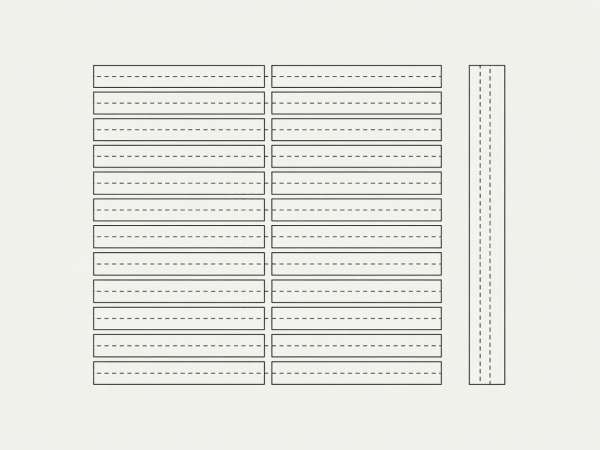
Fig 05. Zero-waste lumber cut map: twelve 8-foot 2x6 boards yield all four walls at 22 inches high.
Saturday Assembly & Sunday Backfill
- Build Two End Panels on a Flat Driveway (45 mins): Lay two 20-inch 4x4 corner posts parallel on your driveway or workbench. Align four 48-inch end boards flush across the posts, clamping each course tightly before driving two 3-1/2" exterior structural screws per board end. Pre-drilling 1/8-inch pilot holes 1.5 inches from the board ends stops dry cedar from splitting.
- Join the 8-Foot Side Walls Upside Down (45 mins): Stand both completed end panels upright and connect them using the bottom course of 8-foot side boards. Flip the entire frame upside down so the top rim rests dead flat on the ground, then work your way up the remaining courses.
- Install the Center Anti-Bow Post & Tie Bar (30 mins): At the exact 48-inch midpoint of the 8-foot rails, screw the remaining two 20-inch 4x4 posts to the inside faces. Connect those two center posts across the middle of the bed with a single 2x4 cross-tie set 8 inches below the rim. When 1.8 cubic yards of rain-soaked soil presses outward, this hidden tie bar keeps the bed laser-straight.
- Staple Hardware Cloth & Scalp the Site (60 mins): While the bed is still upside down, unroll 1/2-inch galvanized hardware cloth across the bottom perimeter and drive heavy 3/4-inch poultry staples every 4 inches. With a partner, carry the frame to your sunny garden site, trace its outline with a flat spade, skim off the grass sod inside the rectangle, and level the subsoil with a 4-foot spirit level.
- Layer Coarse Woody Debris & Screened Topsoil (90 mins): Flip the bed right-side up into its leveled trench. Fill the bottom 6 inches with untreated pruned branches, autumn leaves, and sod clumps turned roots-up (a modified hugelkultur base that cuts soil costs by 25%). Fill the top 16 inches with a 50/50 blend of screened topsoil and mature plant-based compost.
Soil Volume & Budget Breakdown Table
Buying 2-cubic-foot plastic bags of raised bed mix works for a single herb box, but filling a deep 4x8 bed with bagged soil requires 24 separate bags and creates unnecessary plastic waste. Use this conversion table to compare bagged retail spend against municipal or landscape-yard bulk delivery.
| Bed Dimensions (L x W x H) | Total Cubic Feet | Total Cubic Yards (Divide by 27) | 2 Cu Ft Bags Needed | Confirmed Fastener & Mesh Cost | Rough Bulk Soil & Lumber Range |
|---|---|---|---|---|---|
| 3 ft x 6 ft x 11 in (Single Tier) | 16.5 cu ft | 0.61 cu yd | 9 bags | $34 (screws + mesh) | $110 – $170 |
| 4 ft x 8 ft x 11 in (Single Tier) | 29.3 cu ft | 1.08 cu yd | 15 bags | $41 (screws + mesh) | $145 – $225 |
| 4 ft x 8 ft x 22 in (Double Tier) | 58.6 cu ft (42 cu ft w/ twig base) | 2.17 cu yd (1.55 cu yd w/ twig base) | 29 bags (21 w/ base) | $48 (screws + mesh + tie) | $215 – $340 |
| 4 ft x 12 ft x 16.5 in (Three-Course) | 66.0 cu ft | 2.44 cu yd | 33 bags | $62 (screws + mesh + 2 ties) | $260 – $410 |