A Patio That Works Harder
When a builder pours a standard 10x10-foot concrete patio pad behind a house, the math looks generous on paper—100 square feet! Then you place a 48-inch round table, four patio chairs, and a kettle grill. Suddenly, anyone pulling a chair back drops a rear leg into mud, and carrying a tray from the back door requires turning sideways.
Demolishing concrete or hiring a flatwork crew costs thousands. A far smarter weekend challenge is laying a 12-to-18-inch dry-laid paver soldier course around the two outer edges of the slab, paired with a corner planter bench that defines the boundary without blocking breeze or light.
The 20-Linear-Foot Paver Ribbon Expansion
ICPI-Aligned Base Prep
Requires: Flat transfer shovel, 8x8 steel hand tamper, rubber mallet, mason string, two 1-inch steel screed pipes
Following Interlocking Concrete Pavement Institute (ICPI) residential pedestrian guidelines, a paver border never sits directly on topsoil. Even a decorative perimeter needs 4 inches of compacted dense-graded base aggregate (road base or crushed run) topped with exactly 1 inch of coarse washed concrete sand (ASTM C33).
- Concrete Pavers (6x9" Holland)42 Pavers (Laid 9" Wide for 21 Linear Ft)
- Dense-Graded Crushed Base14 Bags (0.5 cu ft each) Crushed Paver Base
- Screed Bedding Sand4 Bags (0.5 cu ft each) Coarse Concrete Sand
- Rigid Paver Edge Restraint3 Sections (7 ft each) + 18 Steel 10" Spikes
- Polymeric Joint Sand (Confirmed)1 Bucket (40 lb) Haze-Free Polymeric Sand
Expand Drainage Slope Calculation (1/4" per Foot Rule)
Before digging, lay a 4-foot carpenter's level on your existing concrete slab pointing away from the house foundation. Confirm that the slab pitches away from the house at roughly 1/8" to 1/4" per foot. Your new paver border must match this downward pitch so rainwater sheets off the slab, across the pavers, and into the lawn rather than pooling at the joint seam.
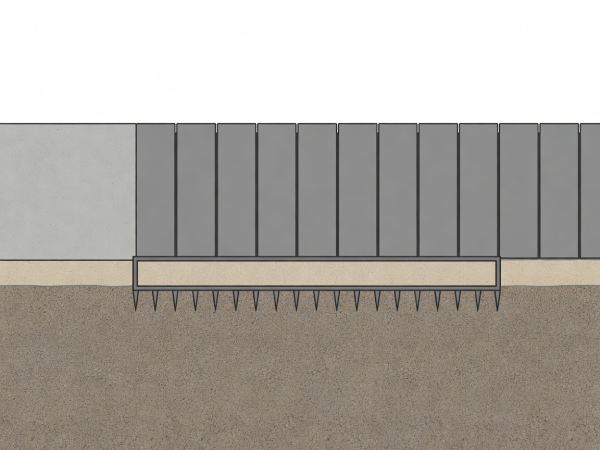
Fig 06. Flush transition joint: set dry pavers 1/4 inch proud of the slab before final tamping.
Excavation, Screeding & Polymeric Lock
- Cut a 15-Inch Wide Trench Along Two Slab Edges (120 mins): Although your pavers are 9 inches long, excavate 15 inches wide so the rigid plastic edge restraint and 10-inch steel spikes sit fully on compacted stone base rather than soft lawn dirt. Dig to a depth of 7.5 inches below the top of your concrete slab (accounting for 4" base + 1" sand + 2.375" paver thickness).
- Compact Base Aggregate in Two 2-Inch Lifts (90 mins): Never dump 4 inches of crushed stone base at once; a hand tamper only compacts the top 2 inches properly. Spread 2 inches of dampened paver base, tamp thoroughly with overlapping blows of an 8x8 steel hand tamper, then add and tamp the second 2-inch lift until firm.
- Screed the 1-Inch ASTM C33 Sand Layer (45 mins): Lay two 1-inch outside-diameter steel conduit pipes parallel along the compacted stone base. Pour coarse concrete sand between them and pull a straight 2x4 scrap across the pipes to leave an exact, uncompacted 1-inch sand bed. Pull the pipes out and fill their grooves by hand.
- Set Pavers & Spike the Edge Restraint (75 mins): Place each 6x9 paver straight down onto the sand bed—never slide pavers sideways or you will bulldoze the screeded sand. Butt the first paver tightly against the concrete slab edge. Once the row is complete, press rigid L-shaped paver edging firmly against the outer paver faces and drive 10-inch spiral steel spikes every 12 inches.
- Tamp Pavers, Sweep Polymeric Sand & Mist (60 mins): Cushion your steel tamper with a scrap of old carpet and tamp across the paver faces to seat them into the sand bed flush with the concrete slab. Sweep dry polymeric joint sand into all seams until 1/8 inch below the paver chamfer, blow EVERY grain of dust off the paver tops with a leaf blower, and mist gently with a shower nozzle to cure the polymer binder.
Patio Upgrade Cost & Effort Ledger
| Upgrade Module | Footprint Gained / Saved | Confirmed Hardware & Prep | Rough Stone / Lumber Spend | Weekend Effort |
|---|---|---|---|---|
| 20-Ft Soldier Course Paver Ribbon | +15 sq ft perimeter margin | $64 (edging, spikes, polymeric sand) | $95 – $145 (pavers + bagged base/sand) | 9 Hours (Moderate digging) |
| L-Shaped Corner Planter Bench | Replaces 4 loose chairs (+18 sq ft floor space) | $52 (structural screws, 4" L-brackets, liner) | $160 – $240 (two 2x12 cedar bench planks + 2x6 cube boxes) | 6 Hours (Carpentry only) |
| Bistro String-Light Planter Posts (Pair) | Overhead canopy without drilling house fascia | $48 (stainless eye bolts, turnbuckles, quick-links) | $115 – $165 (two whiskey half-barrels, two 4x4x10 cedar posts, 4 bags concrete) | 4 Hours (12-hr cure wait) |